Sunday, October 15, 2006

The Informer (1935) and Mary of Scotland (1936) - both DVD

Saturday, October 14 / Thursday, October 26, 2006

Still at the start of the John Ford filmography, I'm getting a chance to see the creation and experimentation of the director's technique, and I'm constantly surprised at the dichotomy among his movies as being either underwhelming or utterly spectacular. Before I started this queue through Ford history I was only acquainted with the films that made him famous, pictures like The Searchers (1956), She Wore A Yellow Ribbon (1949), My Darling Clementine (1946), etc. I love all of those movies and Ford sticks out as one of my favorite directors. My affection also created a set of expectations for him, and in the back of my brain I imagined every movie he made was as fantastic as the ones I already knew. I don't discredit myself for that either; it's natural to think everything a favorite director makes will be great. When I first began looking at film seriously (sometime in the late high school years), my as yet uninformed opinion told me that Scorsese was infallible, that he was The Best director hands-down. Then I started watching more movies and quickly realized that's a tough title to defend. Scorsese is still one of my favorites and I always find something singularly great in his movies, if not the entire picture itself, but for all of his influence he is not film's finest.

As I watch Ford's earlier obscure movies, like my experiences with Scorsese, there is something intriguing about all of them, too. They're not all masterpieces, but there is always something redeeming in them that catches my eye. It can be anything from a single shot composition or angle of light to the repeated use of an actor. Sometimes it's really not much, but there hasn't been one movie yet that didn't make me think about it historically, compositionally or otherwise. The two that are the subject of this post are good examples of the disparity in the overall product of his films; The Informer (1935) is an "experimental" work that plays with stylized lighting, camera work and sets; it's 100% "artistic," a trait Ford never liked put to his work, according to Joseph McBride's biography In Search of John Ford: A Life. McBride explains that Ford, as an emotionally-guarded Irishman insecure of his masculinity, defensively referred to his filmmaking as "work," not art. Mary of Scotland looks just as experimental for Ford as The Informer, with soft close-ups on Mary's (Katherine Hepburn) face contrasting with cavernous interior shots. What is striking about the latter film was a resemblance I noticed it had to Citizen Kane (1941) in terms of its low-angle camera placements and masterful use of shadow. On this note I should add that the cinematographer was not Gregg Toland (of Kane fame), but Joseph H. August, who worked with Ford again in 1945 on They Were Expendable. Toland took cinematography credit on two of Ford's films that did, however, precede Kane by one year in 1940, those are The Grapes of Wrath and The Long Voyage Home.

The Informer and Mary of Scotland have a similar aesthetic that employs Ford's artistic experimentation, though the former is my favorite of the two, entirely due to its story. The Informer looks like a preface to The Grapes of Wrath; it is a socially-conscious film that follows a homeless, penniless man named Gypo (Victor McLaglen) (the name alone spells tragedy) who informs on his wanted friend to pick up reward money. We follow him through foggy streets of the Von Sternberg nature as his conscience eats at him for his desperate action. Yet the prospect of a 20 Pound reward gives him an alternative to starvation. Gypo blows the cash in one night, and his inner demons, as illustrated by the damp, shadowed streets, come out looking like a bad dream.

Mary of Scotland utilized massive sets that resembled the setup of live theater. Katherine Hepburn's intonation certainly hints at a higher, more affected way of speaking that's often associated with stage, and all of the character interactions felt physically awkward, as if they were choreographed for the stage, yet shot on film. What looked like a hint of Kane in this picture were the low-angle shots that threw off the balance of the set, making the ceilings look taller (though they were already tall on their own), and emphasized details of the mise-en-scene: big fireplaces, elaborate woodwork, costumes and tapestries. The endless adornments on set would seem to absorb the echoing space, but there remains plenty to spare.

Both of these films provide an historical thread that leads me to my Ford favorites of later days. One (The Informer) comes out on top as a favorite, while the other (Mary of Scotland) is a reference point for changes and experimentation in Ford's technique; both are valuable in understanding what came next.

What's next on the Ford queue? Young Mr. Lincoln (1939).

Wednesday, October 11, 2006

The Lost Patrol - 1934 - DVD


Wednesday, October 11, 2006

The Netflix queue was a bit out of chronological order for awhile, but you can stop worrying, it's fixed now.

After a run-through of Stagecoach (1939) and Fort Apache (1948), and a virgin screening of Drums Along the Mohawk (1939), I am back on track with The Lost Patrol (1934), which was originally meant to succeed my viewing of Ford's awkward themes and genre manipulation in the 1931 film, Arrowsmith.

Arrowsmith was boggling and The Lost Patrol was not a whole lot more coherent. Though, at least its scenery was consistent: A gang of army men wander the desert during the first World War, they are an organized team looking for food, water, and shelter from stray, almost imaginary bullets from an enemy that is rarely seen. A military patrol unit lost in the desert between warring lands, yes, the title says it, they are The Lost Patrol.

After the opening credit sequence, which does not behold its director title with the anticipation and stature that Ford's later films do (Fort Apache and The Searchers (1956), for instance), there is one neatly framed shot that foresees the kind of Fordian long shots through shadowed door or window frames, the crossed trunks of silhouetted palm trees that create a border for the wide, dry desert beyond. A few panoramas of the landscape are outright gorgeous as patches of shadow show the depth and distance of the space that consumes the soldiers.

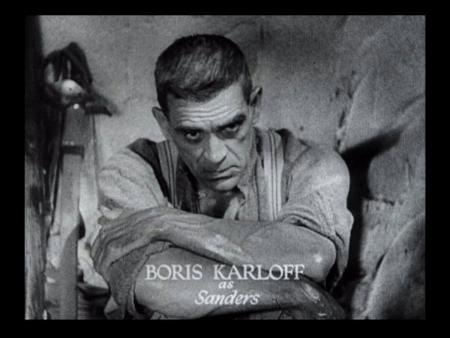
Boris Karloff's character, Sanders, is the most awkward element, outside of the stilted dialogue scenes of soldiers reminiscing about home.
It's partially my own fault that Karloff sticks out so much, because all I can imagine is him grunting about in The Mummy (1932) and Bride of Frankenstein (1935). (Splendid movies, by the way.)

RKO Radio Pictures financed this one, and the next film up on my list, The Informer (1935). In the year between the two releases Ford pumped out three more pictures, two financed by Fox and one by Columbia. I don't know the significance of his history with the production companies, not yet anyway. So if you, dear reader, have any insight on that let me hear it.

Monday, October 9, 2006

The Departed - 2006 - Film


Monday, October 9, 2006

Before I had a chance to post anything about The Departed here on my own blog, controversy was aroused over at Tativille, where a nice bunch of us typed our opinions and debased one another's thoughts, or at least tried to. Because I am exhausted on the subject there'll be no formal post on my end here. But for anyone who is interested, and who isn't already one of the participating members of the debate, I refer to you to Tativille.

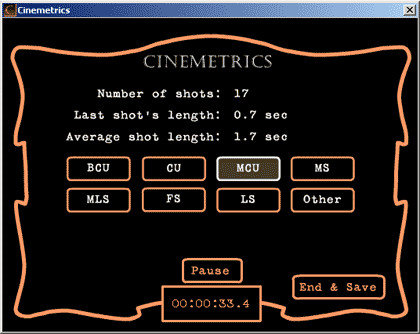
I have a few additions to my ideas on The Departed, most of them concerning the Bordwell reference on shot length, a quantifying process still in its scientific infancy. It's an intriguing idea and practice, that of counting each individual shot within a film, but at this stage of the study it's hard to make heads or tails of the research results--at least as far as I understand it. I understand it through Matt Hauske, who is working directly with the University of Chicago's Yuri Tsivian who pioneered Cinemetrics (That's the formal name for counting shot length, or technically, average shot length [ASL]. Hauske, my dear, please fill in the gaps and correct any mistakes I may have made in my 'Metrics jargon usage. And yes, I'm authoring the diminutive of Cinemetrics now, 'Metrics. Copyright that.)


The issue with relying on ASL (at least at this point) to deconstruct a film is two-fold. First, the process does not qualify any shot with description of its content (e.g. mise-en-scene, camera angle, lighting), and the numbers themselves are misleading (e.g. one shot may be 2 minutes in length, the next 2 seconds; take the average of that and it is likely a much different aesthetic than what was produced in the actual film.) If Scorsese's film, then, is deemed "pornographic" in its violence, based solely on the number 2.7, the ASL as noted by Bordwell, we don't actually have a film that flipped by so fast that our brains didn't process the images; the grotesque imagery did not (entirely) come in flashes of 2.7 seconds. I stand by my original example of the scene where Martin Sheen's character plunges to the ground from a high-rise. If memory serves, the freefall is significantly longer than 2.7 seconds, and his final crash to the asphalt gives us a moment of pause among the gore, and grief shown on DiCaprio's face.

I'm not an expert on this ASL/Cinemetrics stuff, but I did want to point out some of the problems with it, despite my own respect and curiosity for the study.

Hauske should enlighten us, and also, he has a Cinemetrics t-shirt.

Riding Alone for Thousands of Miles - 2006 - Film

Tuesday, October 3, 2006

Coming Soon: Read my review in Four Magazine.

Sunday, October 1, 2006

The Blot - 1921 - Film

Sunday, October 1, 2006

The University of Chicago's Doc Films, began its series, "The Women of Early Hollywood: Writers, Directors, Stars" on October 1st with Lois Weber's The Blot (1921), and other short films. For those unfamiliar with Doc Films, it is a student-run film series program "on record with the Museum of Modern Art as the longest continuously running student film society in the nation," according to the Doc website. The program also provides a glimpse into the Gothic buildings of the University of Chicago; housed in Ida Noyes hall, dark wood, thick draperies, and varnished stone floors are the first thing you notice when you enter the main building. I felt like I stepped back in time to the nineteenth century. This building, like most on the University of Chicago campus, has a regal, intimidating air. Later, as I wandered through some of the adjacent rooms off the common area, I stopped and admired an enormous wooden table that had the dimensions of a decent sized bedroom. Antique lighting shone brownish hues over it all, and any ambient sound was immediately absorbed into the dense atmosphere; it was quiet. I think ghosts live there.

Beyond a few sets of double doors, however, is a brighter scene. Pinkish carpet leads into the main theater, The Max Palevsky Cinema, bigger and more spacious than most theaters, and clean. It wasn't the lecture hall venue I always imagined. A shy student introduced the films, and a live pianist, a music student from the U of C, brought a kind musical compliment to the otherwise silent theater.

A House Divided (1913) and Matrimony's Speed Limit (1913) are two Alice Guy Blache films, who according to Doc notes is the "first person to direct a narrative film." A House Divided is a gem of a flick about a husband and wife whose bickering has become so volatile that they no longer speak, and instead resort to hand-written notes to communicate. The film is in long shot, cuts only when the scene ends, and was on an immaculate print. The image was a buttery black and white, with no over/underexposures, and for a moment I thought it was a cleaned up DVD copy of the movie. The same goes for Blanche's second film Matrimony's Speed Limit. A clean print of a film about a man who receives a telegram that he is about to inherit the family fortune. The hitch? Well, he's got to be hitched by 12:00 noon in order to collect. Ensuing are his vain attempts to lure random women off the street to marry him, intercut with his real wife-to-be at home and about town in search of him. The final scene stages their marriage as they stand up in the backseat of their car, one minute from the noonday chime, and blocking traffic. Now that's a wedding.

The last short was a Lois Weber flick, Suspense (1913), with director Phillips Smalley listed as co-director, who was also Weber's first husband (they divorced in 1922). The story is basic: a burglar is lurking outside a woman's home while her husband is away at work. There are split screen shots holding the woman, her husband, and the burglar in separate frames, and a brilliant scene of the husband speeding home in a stolen car, revealing the police in hot pursuit behind him in a shot that looks at them in the reflection of the car's side view mirror.

The Blot (1921) was the main feature, a film I had seen years ago, though not actually on film (I believe it was a DVD copy, or maybe video). The film, at heart, is about class; two neighboring families live under separate financial spheres, and therefore different social spheres. Weber illustrates a prosperous 1920s that is still leaden with a poor population; the class barrier is shown directly, placing the wealthy family next to the poor one, where only a thin fence separates the households’ properties. A romance between a wealthy student who falls for his professor's daughter finally closes the social gap between the two detached families, and all become friends. The film’s melodrama is deliberate to overtly show extant social perils among general prosperity.

The print of The Blot was also in immaculate condition, though one reel was spooled incorrectly and flipped the image of the film. The projectionist stopped and rewound it to start again, which didn’t bother me. Anybody who attends a silent film from 1921 at a south-side venue on a late Sunday night has to be a movie lover, so it gave me a moment to remember I was among a patient crowd who showed up at this aged building for the same simple reason as me, the movie.

The Dogwalker - 2006 - Film

Sunday, October 1, 2006

Read my review in Four Magazine!

Jackass: Number Two - 2006 - Film

Saturday, September 30, 2006

My boyfriend always says that in order to understand males you must know that their best form of affection is mockery. Apparently, cut-downs and one-up-manship is the bond that keeps guys together, that let's them know their companionship is appreciated and valued. With this train of logic, I watched Jackass: Number Two wondering if it was true. The Jackass guys take insults to a new level, a physical one. Making your friend wrap his penis in a bunny costume, and forcing it through a hole of a snake's cage, then, is at once a measure of pain (once the snake bites--and it does) and camaraderie.

The premise seems absurd: An overgrown group of boys purposely inflicting massive physical pain and torture upon one another only to rub it in with laughs and screams. Why would they do it? And more importantly, why did I enjoy watching it? Women would never do this to each other, at least not in my experiences. Is there a female "Jackass" troupe out there now? My guess is no. For whatever reason I imagine women have a finer ruling not to place their genitals into the venomous grip of sharp-toothed animals. Then again, most males wouldn't volunteer for such physical distress either, just the Jackass team. Nonetheless, there is no female member of the Jackasses, which is not to conclude that these men are stupid for their engagement in such extreme stunts, just that women clearly are not a part of them.

I agree with our friend Matt, that the Jackasses are not dumb, but rather "perfectionists." They are not stand-up comics, their spoken stories are not enough to keep us entertained, but they are physical comedians, and probably the closest human thing to a cartoon, albeit an adult cartoon. They engage in stunts that at the very least bruise them or make them vomit, but others that are without a doubt life threatening. Johnny Knoxville, who reaches the most dire heights of Jackass tricks, in one scene straps himself to a rocket aimed to propel him 50 feet (or more?) into the air, from which point he freefalls into a lake below. Knoxville, who was in that instance mere inches from death, compares his tricks to cartoons himself, telling Blender.com, "I personally almost died twice: once from a rocket that exploded while I was riding it Wile E. Coyote/Dr. Strangelove–style, and once from a 25-foot steel wall that fell on me."

It is not as if Knoxville and the Jackasses are not aware of the risks they are taking; they know they will get hurt, and that is the point. They fashion their tricks to avoid the worst-case scenario (i.e. severe bodily trauma, death), they are showmen of the most grotesque kind, and it seems that the longer these guys inflict pain on each other, the better friends they are. After all, the group has been together since the start of their eponymous MTV series in the late nineties. I am still not sure I completely understand this proposed male companionship based on sly insults and practical jokes, it seems like an awfully cruel way to express the pleasure of a friendship. Though, if forcing another pal to drink horse semen doesn’t tear these friends apart, maybe there’s something to it.